
Seafarer Employment Agreements: What Yacht Crew Must Check Before Signing
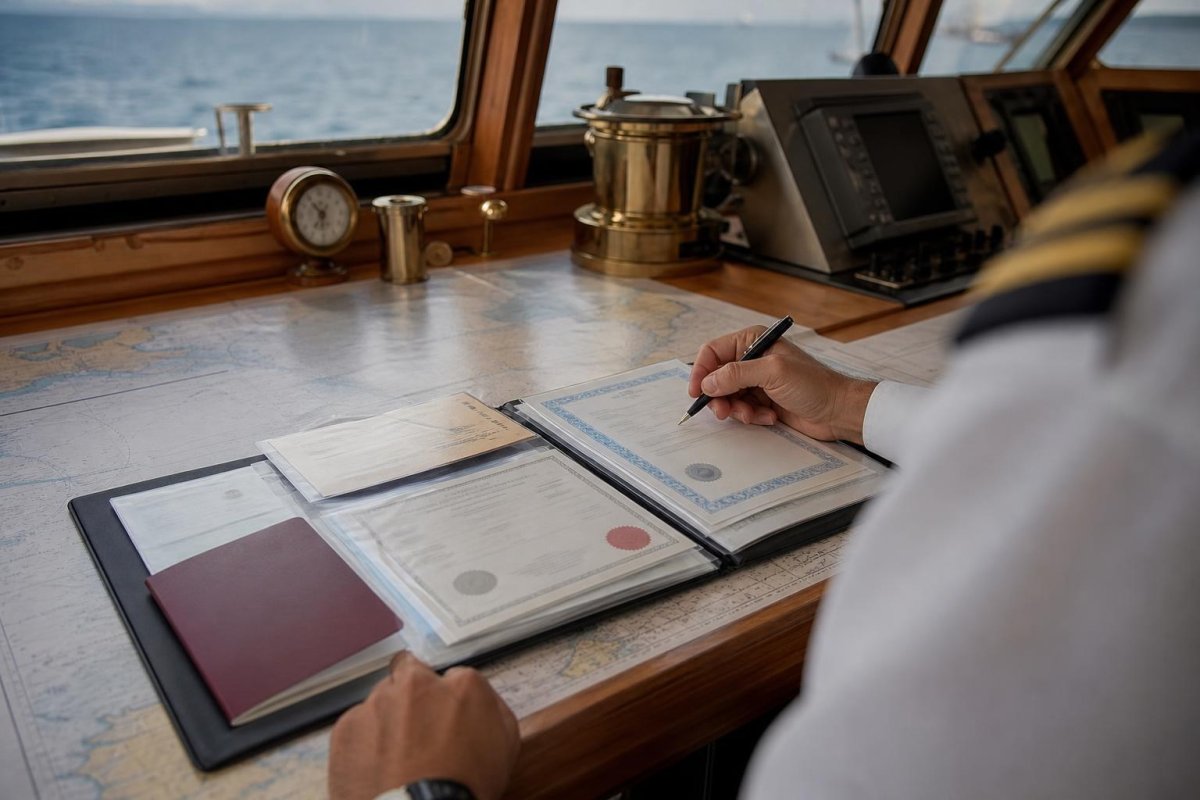
Seafarer Employment Agreements: What Yacht Crew Must Check Before Signing
Your Seafarer Employment Agreement is the contract that says what you are paid, how much leave you get and who flies you home. Here is what the Maritime and Coastguard Agency says it must contain, and what to check before you sign.
What a Seafarer Employment Agreement is
A Seafarer Employment Agreement, or SEA, is the written, legally enforceable agreement between you and the shipowner or employer for your work on board. It comes from the Maritime Labour Convention, 2006 (MLC), the international convention on seafarers' working and living conditions, which came into force in August 2013. The MLC covers five areas: the minimum requirements to work on a ship, conditions of employment, accommodation and food, health protection and welfare, and compliance and enforcement.
For UK ships the rules are set out by the Maritime and Coastguard Agency (MCA) in Marine Guidance Note MGN 477 (M) Amendment 5, published in February 2025. The MCA states that every seafarer on a vessel the regulations apply to must have an SEA, and that SEAs replaced the old collective crew agreements on those vessels.
Which yachts it applies to
The UK regulations apply to sea-going UK ships wherever they are, and to non-UK ships in UK waters. They do not apply to pleasure vessels or to vessels that are not ordinarily engaged in commercial activities. In yachting terms: a commercially operated yacht, such as a charter yacht, falls under the MLC rules; a purely private yacht generally does not, so your protection there depends on the contract you are offered and on the flag.
The flag at the stern shows where the yacht is registered, and it is that flag state's law which governs your agreement. Other red ensign and MLC flag states follow the same convention, with their own guidance. Ask which flag the yacht flies and whether she is operated commercially before you accept.
What your SEA must contain
Annex 1 of MGN 477 lists the minimum information. Use it as a checklist.
| Your SEA must state | What to look for |
|---|---|
| Who you are | Your full name, birthplace and date of birth or age |
| Who the shipowner is | The shipowner's name and address. If you are employed through a third party, the employer signs too and the shipowner guarantees the employer's obligations |
| Where and when | The place and the date the agreement is entered into |
| Your position | The capacity in which you are to work |
| How long it runs | The end date for a fixed period; for an open-ended agreement, the notice period and when notice may be given; for a single voyage, the destination port |
| Wages | The amount or the formula, how you are paid and the pay dates. Pay dates may be no more than one month apart, the first within a month of the agreement |
| Hours of work | The hours you are expected to work |
| Paid leave | The amount or the formula used to work it out |
| Health and social security | The health and social security protection benefits the shipowner provides |
| Repatriation | Your entitlement, including the mode of transport and the destination, and any circumstances in which you would have to meet the cost |
| Maximum time on board | The longest period of service after which you are entitled to repatriation |
| Loss of belongings | The maximum compensation for personal property lost if the ship is lost or founders |
| Pension | Any pension benefits or scheme you may join |
| Grievance and discipline | The procedures that apply on board |
| Collective agreement | Details of any collective bargaining agreement that forms part of your SEA |
If you are self-employed rather than an employee, the MCA still requires an SEA. It must contain the general items above, plus your remuneration and how and when it is paid.
Your rights before you sign
- You must be given the opportunity to examine the agreement and seek advice on it before signing.
- The SEA must include a signed statement that you had that opportunity, that your rights and responsibilities were explained, and that you entered into it freely.
- It should be written and presented clearly enough for you to understand the terms. The MCA recommends a translation where crew do not read the language it is written in.
- You must be given a signed original as soon as possible after signing. A copy is also kept on board.
- An agreement may not contain terms contrary to UK law. The MCA's example is a clause forbidding you to join or contact a trade union.
Ask for the SEA before you travel to join the yacht, not on the passerelle.
Notice periods
The notice period must be written into the SEA, must be at least seven days, and must be the same for both sides: the shipowner cannot ask you for longer notice than they give you. Shorter notice is allowed without penalty on compassionate grounds or for gross misconduct, and the SEA should say what those mean. The MCA says it will query notice periods that are unduly restrictive on seafarers, such as several months.
Time on board and getting home
On a UK ship you are entitled to repatriation when your SEA expires, or after a maximum of 11 months of continuous service on board. The MCA says extensions beyond the contract are a last resort, need your informed consent, and that a valid SEA must stay in force until you are home. Where an extension takes a seafarer past 11 months, the shipowner has to notify the MCA.
The convention itself also sets a floor for leave and rest: paid annual leave of at least 2.5 calendar days for each month of employment, and at least 10 hours of rest in any 24 hours and 77 hours in any seven days.
When you leave the yacht
The shipowner must give you a record of your employment on board: the ship, your capacity, the date you started and the date and place of discharge. It may be an entry in your discharge book or a certificate of discharge. It must not include any comment on your conduct or your wages. Keep it: it is your proof of sea service.
If something goes wrong
- Raise it on board first, through the yacht's on-board complaint procedure, which UK sea-going ships are required to have.
- If that does not resolve it, raise it with an authorised officer in the port where the yacht is lying. In a UK port that is the nearest MCA Marine Office.
- Court action is the last step. The MCA notes that UK ships are subject to UK law but that proceedings need not be in a UK court.
The MCA's Seafarer Services team can be reached at [email protected]. The MCA also recommends that shipowners follow the ITF and ICS guidance on eliminating shipboard harassment and bullying.
A two-minute check before you join
- Is the yacht private or commercial, and which flag does she fly?
- Do you have the SEA in your hands before you travel?
- Does it name the shipowner, not only a management company or agency?
- Are salary, currency, pay date, leave and notice all written down, and do they match what you were offered? Our Yacht Salary Guidelines 2026 show the current ranges.
- Does it say who pays to get you home, and to where?
- Have you kept your own signed copy somewhere off the yacht?
Keep your paperwork in one place
Your Crew HQ profile holds your CV, certificates and references, and reminds you before a document expires. Register free, and see who is hiring on the yacht jobs page.
Sources
Maritime and Coastguard Agency, MGN 477 (M) Amendment 5: MLC 2006 seafarer's employment agreements, and the MCA's MLC 2006 titles 1 to 5 guidance, which carries the model SEA format; both read on 13 October 2026. This article is a plain-language summary for crew, not legal advice. Yachts under other flags follow that flag state's rules: check with the flag or take advice before you sign.
Keep reading
All news October 2026Mental Health for Yacht Crew: Where to Get Help and How to Look Out for Each OtherFree, confidential help for yacht crew at any hour, the signs to notice in yourself or a crewmate, and what captains can do on...Read
  October 2026Yacht Salary Guidelines 2026Yacht crew salary ranges for 2026 by position and yacht size, from deckhand to captain, with leave and rotation, drawn from two...Read
  October 2026Who You Know Gets You the Job: Your Crew HQ NetworkCrew HQ now has a crew network: connect once with the people you have worked with, hear about their jobs first, recommend each...Read
 Put it to work on Crew HQ
 For crew
Be found by the people who hire
One profile for your CV, references, certificates and availability. Captains and managers search it directly.
Create your free profile For captains and recruiters
Hire without a middleman
Search crew by role, experience and location, open full profiles and contact them yourself.
Search crew For companies
Put your business in front of crew
A free page in the yachting directory and a pin on the service map. Upgrade when you want more.
List your companyWho you know gets you the job
In yachting, who you know matters. On Crew HQ the crew you have worked with become your network, and your network works for you.
- Jobs reach you first
When someone in your network is hiring, you are told straight away, before the job goes to everyone else.
- Crewmates recommend you
The people you have worked with say what you are good at. Captains see it on your profile beside your references and crew rating.
- Stay in touch
You and your network see each other's contact details and where each of you is, on your own network map.
- Offers from people you know
Companies and training schools in your network send their special offers to you as they publish them.
- A month of Premium
Every 5 people who join through your Crew Link give you a month of Premium, free.
If you and everyone in your network each had 20 crew in your networks
you would be told first about jobs from up to 400 crew20 in your own network, plus 380 through theirs with Premium or Professional.
Join, and you get your own Crew Link at once. Send it to the crew you have worked with: each one who opens it is in your network.
Join free and get my Crew Link Already a member? Log in